Know your tools. Choosing the right needle, tube, and assembly for each patient is the foundation of a successful, safe draw.
⭐ 35 XP on completion
Blood collection tubes organized by order of draw
Image
Watch: Phlebotomy Skills — Order of Draw
Video
CLSI Order of Draw
Diagram
✨ To best master this material, we use a Learn It → Live It → Share It approach: read the concept, apply it in a real scenario, then reinforce with shareable study cards.
💉 Needles
Gauge
Lumen Size
Best Use
18G
Large
Rapid blood product donation; large-volume draws
20G
Medium-large
Average adult with good veins; most routine draws
21G
Medium
Standard venipuncture — most common in clinical labs
22G
Medium-small
Small or fragile veins; pediatric patients
23G
Small
Very fragile/elderly veins; butterfly preferred
25G
Very small
Neonates, infants; scalp veins
💡Gauge Rule: The HIGHER the gauge number, the SMALLER the needle lumen. Think of it inversely — 25G is tiny, 18G is large. Smaller gauge (larger needle) flows blood faster but may damage fragile veins.
Butterfly (winged infusion set) — 21G–25G; flexible tubing; excellent for small/rolling veins, hand veins, and pediatric patients; single tube without detaching typically
Syringe needle — Attached to syringe for manual aspiration; used when vacuum tubes collapse the vein
⚠️Safety Needles Required: OSHA mandates the use of safety-engineered needles with passive or active sharps protection. Never use needles without a safety mechanism. Activate the safety device with one hand immediately after withdrawal.
🏺 Vacutainer Tubes Overview
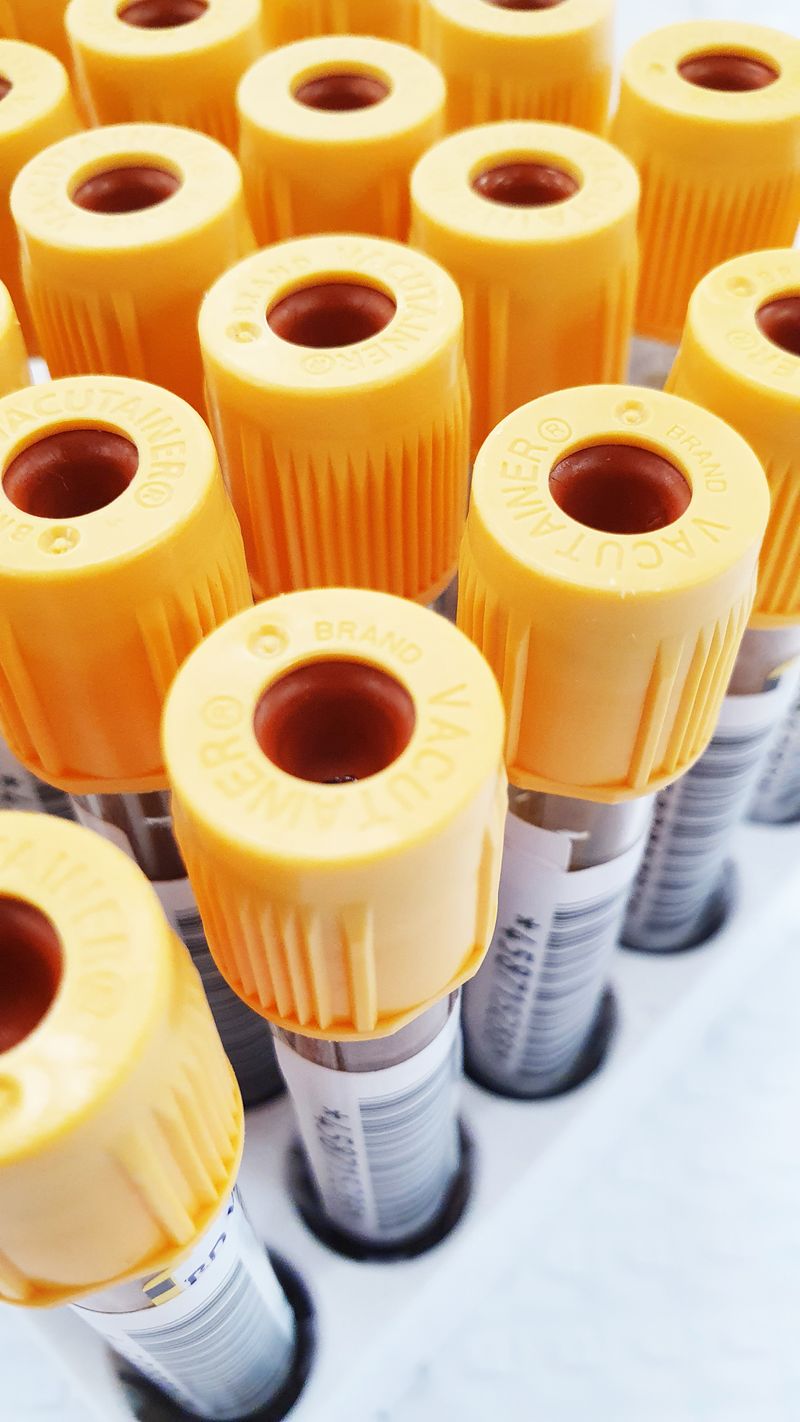
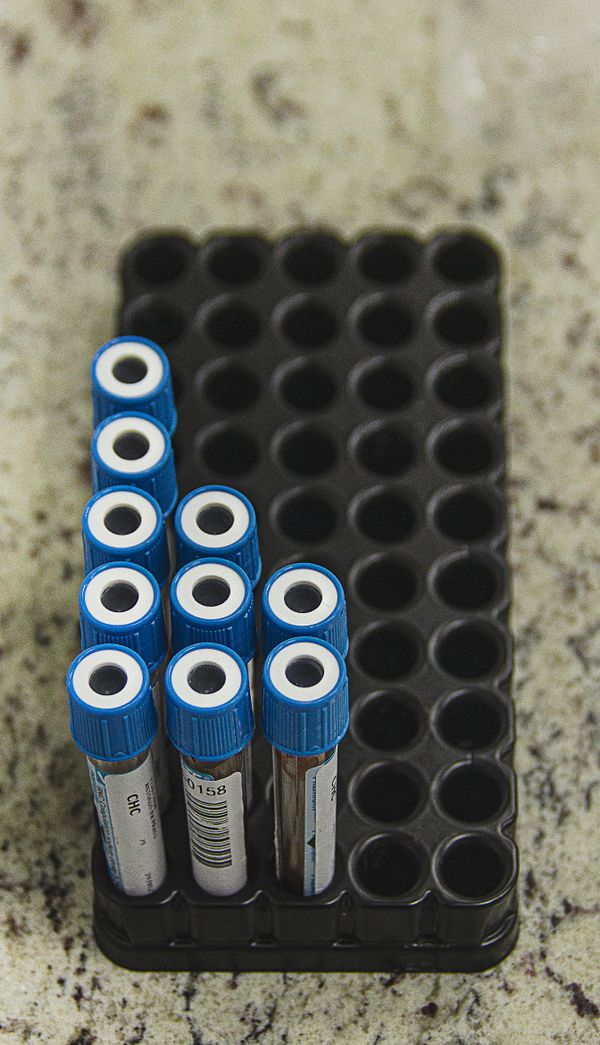
Vacuum collection tubes are color-coded by their stopper, which indicates the additive inside. Always verify the correct tube for each test ordered.
🔴 Red / Red-Gray (SST)
No additive / Clot activator + gel
Chemistry, serology, blood bank
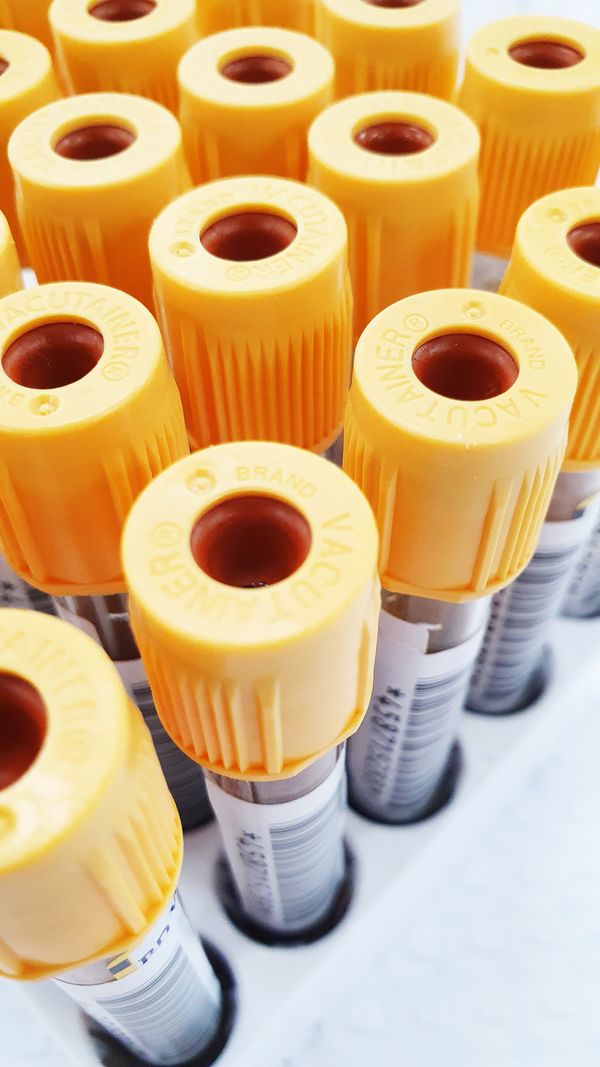
🟡 Yellow (SPS)
Sodium polyanethol sulfonate
Blood cultures (sterile)
🔵 Light Blue (Citrate)
Sodium citrate 3.2%
PT/INR, PTT, coagulation
🟢 Green (Heparin)
Sodium or lithium heparin
STAT chemistry, electrolytes
🟣 Lavender (EDTA)
EDTA (anticoagulant)
CBC, blood smear, blood bank
🟠 Orange (Thrombin)
Thrombin + clot activator
STAT serum chemistry
⚫ Gray (Oxalate/Fluoride)
Sodium fluoride + potassium oxalate
Glucose, lactate (glycolysis inhibitor)
🔴 Royal Blue
No additive or EDTA (trace metal free)
Trace metals (lead, zinc, copper)
💉 Gauge Selection — Matching Needle to Situation
Needle gauge (G) is an inverse measure — the higher the number, the smaller the diameter. Selecting the correct gauge directly impacts specimen quality and patient comfort:
Gauge
Color
Use Case
Consideration
20G
Yellow
Large-volume draws, blood bank, blood donation
Fastest flow; uncomfortable in small veins
21G
Green
Routine venipuncture — the standard
Balanced flow rate and patient comfort for most draws
22G
Black
Smaller veins, elderly, pediatric veins in older children
Slower flow — watch for vacuum collapse in fragile veins; use syringe or butterfly
23G
Blue
Very fragile veins, dorsal hand, pediatric, geriatric
Slow flow; risk of hemolysis if vacuum tubes used with small fragile veins — butterfly recommended
25G
Orange
Very small veins; insulin injections (not standard phlebotomy)
Rarely used for lab draws — risk of RBC damage and hemolysis; only in extreme circumstances
The hemolysis-gauge relationship: Smaller gauge needles create higher shear stress on red blood cells as they pass through the narrow lumen, especially when vacuum tube pressure is high. This is why drawing through a 23G needle into a large vacuum tube (with high draw pressure) causes hemolysis. The solution: use a syringe draw and transfer gently, or use a butterfly with limited vacuum.
📝 Knowledge Check
1. A 23-gauge needle compared to a 21-gauge needle has:
Gauge is inversely related to lumen size. 23G = smaller lumen than 21G. Higher number = smaller hole. This matters because smaller gauge needles flow more slowly — important for fragile veins but limits draw speed.
2. A PT/INR (coagulation study) requires which tube color?
Light blue (sodium citrate) tubes are used for all coagulation studies: PT/INR, PTT (aPTT), fibrinogen, and D-dimer. Sodium citrate chelates calcium to prevent clotting — the lab then adds calcium back to run the test.
3. Which tube is used when you need to prevent glycolysis (sugar breakdown) in a glucose specimen?
Gray-top tubes contain sodium fluoride, a glycolytic inhibitor that preserves glucose by preventing RBCs from metabolizing it. Without fluoride, glucose drops 7 mg/dL per hour at room temperature. Gray is required for accurate glucose and lactate testing.
⚡ Live It — Real-World Scenario
🔧 Live It — Equipment Failure Mid-Draw
You've inserted the needle, blood flashes — but as you push the first tube onto the holder, it cracks and separates. Blood seeps at the puncture site.
💬 What is the correct immediate response?
Patient safety first: (1) Apply gentle pressure with gauze — do NOT try to reattach the holder in the arm. (2) Carefully withdraw the needle, activate the safety device. (3) Apply firm pressure 2-3 minutes. (4) Dispose of broken equipment in sharps container. (5) Assess for blood exposure — follow exposure control policy if skin/mucous membrane contact. (6) Inspect patient for hematoma. (7) Select new intact supplies and redraw from a different site if needed. Always inspect equipment before use.
Coach Phoebe
The order of draw exists for a reason — cross-contamination of additives can ruin results!
📢 Share It — Study Cards & Patient Education
📇 Flip Cards — Study with a Partner
Tap each card to reveal the answer
What are the 3 main components of the ETS?
Evacuated collection tube, tube holder (adapter), and double-pointed needle with safety device.
What is the purpose of a safety-engineered sharp?
Automatically shields or retracts the needle after withdrawal to prevent needlestick injuries. OSHA requires their use.
🏥 Patient Education Tip
Phlebotomists use specially designed safety needles that retract automatically after use to protect both you and the healthcare worker.
Order of draw is non-negotiable. It prevents additive carryover between tubes — a contamination that can completely invalidate test results and harm patients.
⭐ 45 XP on completion
Row of colored vacutainer tubes
✨ To best master this material, we use a Learn It → Live It → Share It approach: read the concept, apply it in a real scenario, then reinforce with shareable study cards.
🩸 CLSI-Recommended Order of Draw
The Clinical and Laboratory Standards Institute (CLSI) establishes the standard order. Memorize this sequence — it will be tested on the NHA CPT and ASCP PBT exams.
1
🟡 Yellow
Blood cultures (SPS)
Aerobic then anaerobic bottles
2
🔵 Light Blue
Sodium citrate
Coagulation studies
3
🔴 Red / SST
Serum / Clot activator
Chemistry, serology
4
🟢 Green
Heparin
STAT chemistry
5
🟣 Lavender
EDTA
CBC, blood bank
6
⚫ Gray
Fluoride/Oxalate
Glucose, lactate
🧠Memory Trick:"Stop! Let Red Guys Leave Gold" — Sterile (Yellow), Light Blue, Red/SST, Green, Lavender, Gray
⚗️ Why Order Matters — Additive Carryover
When blood flows from one tube into the next via the multi-sample needle, microscopic amounts of the previous tube's additive can contaminate the next tube. This is called carryover.
Carryover Scenario
Effect on Results
EDTA (lavender) → Light blue
EDTA chelates calcium → falsely prolonged PT/INR (EDTA is a potent anticoagulant)
Heparin (green) → Light blue
Heparin is an anticoagulant → falsely prolonged PT/PTT
EDTA (lavender) → Red/SST
Falsely low calcium, other chemistry interferences
Sodium citrate (blue) → Red
Citrate chelates calcium → lowers Ca²⁺ results
Fluoride (gray) → Any
Inhibits enzymes → falsely low glucose and enzyme activity
💡Light Blue First (when only coagulation): If ONLY a light blue tube is being drawn (no blood culture), CLSI recommends drawing a 2.7 mL discard tube first to eliminate air and potential tissue factor contamination that could activate coagulation.
🩸 Fill Volume — The Ratio Rule
Certain tubes require exact fill volumes for accurate results:
Light blue (citrate): Must fill to exactly the line — the 9:1 blood-to-citrate ratio is required. Under-fill = too much citrate → falsely prolonged clotting times. Overfill = too little citrate → falsely shortened.
All vacuum tubes: Allow vacuum to draw blood to the fill line — do not overfill or underfill.
Invert tubes: Gentle inversion required to mix additive — 3–8 times depending on tube type. Never shake vigorously (causes hemolysis).
Tube Color
Inversions Required
Reason
Blood culture bottles
8–10 gentle inversions
Mix blood with SPS preservative
Light blue (citrate)
3–4
Mix with anticoagulant
Red (plain)
0 (or 5 if clot activator)
Allow clotting to proceed
SST (gold)
5
Mix clot activator
Green (heparin)
8–10
Mix heparin thoroughly
Lavender (EDTA)
8–10
Prevent micro-clots in CBC specimen
Gray (fluoride)
8–10
Mix glycolytic inhibitor
🔬 Why Order of Draw is a Patient Safety Issue
Order of draw prevents carryover of tube additives from one tube to the next. When a needle passes through a tube's stopper and into the patient's vein, a tiny amount of the previous tube's additive is carried in the needle's lumen to the next tube. If EDTA (from a purple CBC tube) carries into a chemistry tube, it falsely lowers calcium, magnesium, and other minerals — because EDTA is a chelating agent that binds divalent cations.
CLSI Recommended Order of Draw (ETS/Vacutainer):
Blood cultures (Yellow SPS — sterile, collected first to minimize contamination)
Sodium citrate (Light Blue — coagulation tubes; must be filled EXACTLY to line)
Serum tubes: Plain Red → Gold SST → Tiger-top (clot activator or SST)
Heparin (Green — plasma chemistry)
EDTA (Purple/Lavender — CBC, blood bank)
Fluoride/oxalate (Gray — glucose, lactate)
Syringe order: Same concept, but fill tubes from syringe in the same order. Exception: blood culture bottles are filled last from a syringe (to prevent anticoagulant from the syringe from entering the culture medium and killing bacteria).
The coagulation tube rule: The light blue citrate tube is second only because it requires a blood-to-anticoagulant ratio of exactly 9:1. If EDTA contamination from any prior tube enters it, the coagulation results are invalid. When only a citrate tube is ordered, some guidelines recommend collecting and discarding a red or SST tube first (the "discard tube") to clear the needle of any tissue thromboplastin from the initial skin puncture.
📝 Knowledge Check
1. You need to collect a CBC (lavender), PT/INR (light blue), and BMP (green). In what order should you draw these tubes?
CLSI order: Light blue (coagulation) → Red/SST → Green (heparin) → Lavender (EDTA). Light blue must come before any EDTA tube because EDTA carryover would falsely prolong PT/INR. Green comes before lavender following the standard sequence.
2. You drew the light blue tube but it is only half full. What should you do?
An underfilled light blue tube has too much citrate relative to blood. This falsely prolongs clotting times (PT/INR, PTT). A 9:1 ratio is required. The specimen must be recollected. Sending an underfilled coag tube is a rejection criterion.
3. After drawing a lavender (EDTA) tube, how many times should you invert it?
EDTA tubes require 8–10 gentle inversions to mix the anticoagulant throughout the blood. Insufficient mixing causes microclots that will ruin the CBC. Vigorous shaking causes hemolysis. Gentle end-to-end inversions are the standard technique.
🎭 Simulation Challenge
The Leukemia Recheck
A young leukemia patient's recheck draw — precision and compassion under pressure.
You've inserted at a 15° angle, blood flashes, and the tube begins filling. Two mL fill — then flow stops completely. The patient says it doesn't hurt.
💬 What troubleshooting steps do you take in order?
Systematic troubleshooting (no probing): (1) Try a fresh tube — the current one may be spent. (2) Gently rotate the needle a quarter turn — bevel may be against the vein wall. (3) Advance slightly — may have backed out. (4) Retract slightly — may have gone through the vein. (5) Re-apply tourniquet if released. Do NOT probe or redirect sharply. After 2 repositioning attempts, withdraw and try a new site. Document.
Coach Phoebe
A steady hand comes from a steady mind. Breathe, focus, then proceed.
Clean skin = clean specimen. Proper antisepsis prevents site infection AND prevents microorganism contamination of the blood sample — especially critical for blood cultures.
⭐ 30 XP on completion
Order of Draw Sequence with Tube Colors
✨ To best master this material, we use a Learn It → Live It → Share It approach: read the concept, apply it in a real scenario, then reinforce with shareable study cards.
🧴 Standard Antiseptic: 70% Isopropyl Alcohol
Isopropyl alcohol (IPA) 70% is the standard antiseptic for routine venipuncture site preparation.
Proper Technique
Apply with a swab or prep padSingle-use alcohol swab, applied with moderate pressure to cleanse surface bacteria.
Clean in concentric circlesStart at the intended puncture point, move outward in widening circles — do NOT go back over already-cleaned skin.
Allow to air-dry completely30–60 seconds minimum. This is not optional. Wet alcohol: (a) stings the patient, (b) contaminates the specimen, (c) hemolyzes blood cells at contact.
Do NOT blow on, fan, or wipe dryThis re-contaminates the cleaned area. Just wait. The alcohol evaporates rapidly at room temperature.
Do NOT touch the site after cleaningIf you must re-palpate (e.g., rolling vein), you must re-cleanse the site completely.
🚨Alcohol Not Dry = Hemolysis + Sting: Inserting through wet alcohol causes painful burning AND hemolyzes red blood cells at the puncture site — this hemolysis propagates through the tube and can falsely elevate potassium, LDH, and other intracellular analytes.
🦠 Blood Culture Antisepsis — Two-Step Protocol
Blood cultures are the most contamination-sensitive specimen. A single skin bacterium entering the bottle produces a false-positive blood culture, potentially causing a patient to receive unnecessary IV antibiotics for weeks.
Step 1: 70% Isopropyl Alcohol
Clean the site with IPA, allow to dry completely (30–60 seconds).
Step 2: Chlorhexidine Gluconate (CHG) or Povidone-Iodine
Apply CHG 2% or povidone-iodine (Betadine) and allow to dry for 60–90 seconds minimum — this is a longer contact time than standard prep. CHG is preferred (longer residual activity).
⚠️Blood Culture Bottle Tops: The bottle tops (aerobic and anaerobic) must also be disinfected with 70% IPA and allowed to dry before injection. Total skin contamination rate should be <3% in well-run laboratories.
Antiseptic
Routine Venipuncture
Blood Culture
70% Isopropyl Alcohol
✅ Yes — 30–60 sec dry
✅ Step 1
Chlorhexidine 2% (CHG)
For neonates / sensitive skin
✅ Step 2 — preferred
Povidone-iodine (Betadine)
For iodine-compatible patients
✅ Step 2 — if CHG unavailable
Benzalkonium chloride
Rarely used
❌ Not adequate for blood culture
🧴 Understanding Antiseptics vs. Disinfectants vs. Sterilants
These three terms are often used interchangeably but have distinct meanings in infection control:
Antiseptic: Antimicrobial agent applied to LIVING TISSUE (skin) to reduce microorganism burden. Examples: 70% isopropyl alcohol, chlorhexidine gluconate, povidone-iodine.
Disinfectant: Chemical applied to NON-LIVING surfaces (equipment, counters) to kill pathogens. Not used on skin. Examples: bleach (sodium hypochlorite), quaternary ammonium compounds.
Sterilant: Agent or process that kills ALL microorganisms including spores — used for surgical instruments. Examples: steam autoclave (heat), ethylene oxide gas, glutaraldehyde.
Why 70% alcohol — not 100%? Pure (100%) isopropyl alcohol evaporates too quickly and doesn't achieve sufficient contact time. The 70% formulation includes water, which slows evaporation, improving bactericidal effectiveness. It also denatures proteins more effectively at 70% concentration.
Chlorhexidine gluconate (CHG) for blood cultures: CHG has residual activity — it continues killing organisms even after it dries. This residual activity makes it superior to iodine for blood culture site preparation. 2% CHG is preferred by most guidelines. Allow 30 seconds of friction + 30 seconds drying minimum. Note: CHG is not recommended for neonates under 2 months (skin absorption risk).
Allow to dry! Inserting a needle through wet alcohol introduces alcohol into the specimen, causing hemolysis. Through wet CHG introduces the antiseptic into the blood culture medium, potentially inhibiting bacterial growth and causing a false-negative result.
📝 Knowledge Check
1. After cleaning the venipuncture site with alcohol, you must wait how long before inserting the needle?
Alcohol must fully evaporate before needle insertion — typically 30–60 seconds. Inserting through wet alcohol stings the patient, causes hemolysis, and can contaminate the specimen. Never wipe dry — this re-introduces bacteria.
2. For a blood culture draw, after applying isopropyl alcohol, you should next apply:
Blood cultures require a two-step antiseptic process: IPA first, then CHG or povidone-iodine. The second agent requires 60–90 seconds of dry contact time. This dual approach achieves the contamination rate target of <3%.
3. You cleaned the site, then had to re-palpate to reconfirm the vein. You should now:
Any touch to the cleaned site — even a single finger — re-introduces skin bacteria. You must completely re-clean the site with a fresh swab and allow it to dry again. This is non-negotiable for maintaining a sterile field.
⚡ Live It — Real-World Scenario
🔍 Live It — Three Failed Attempts
You've made two antecubital attempts and one forearm attempt — all produced minimal or no blood. The frustrated patient asks, "Why can't you find a vein?"
💬 What is the protocol, and how do you handle the patient interaction?
Stop and regroup professionally: (1) Most facilities limit to 2 attempts per phlebotomist before escalating. (2) Acknowledge honestly: "I apologize for your discomfort. I'm going to get a colleague to assist." (3) Do NOT attempt a fourth try. (4) Escalate — charge phlebotomist, nurse, or provider. (5) Consider warm compress, ultrasound-guided draw, or IV access. (6) Document all attempts, sites, gauge used, and reason for escalation.
Coach Phoebe
Venipuncture is a skill that improves with every draw. Be patient with yourself.
📢 Share It — Study Cards & Patient Education
📇 Flip Cards — Study with a Partner
Tap each card to reveal the answer
How many attempts should one phlebotomist make?
Maximum 2 attempts per phlebotomist. After 2 failures, escalate to a more experienced colleague.
Name 3 techniques to improve vein visibility.
(1) Warm compress 5-10 min. (2) Gravity — arm below heart level. (3) Adequate hydration. (4) Tourniquet up to 1 minute.
🏥 Patient Education Tip
Staying well-hydrated, warm, and relaxed before your appointment helps make veins easier to access.
This is it — the full procedure, step by step, exactly as you'll perform it in the clinic. Master this sequence until it's muscle memory.
⭐ 55 XP on completion
Fill Volume with Minimum Ratio Markers
✨ To best master this material, we use a Learn It → Live It → Share It approach: read the concept, apply it in a real scenario, then reinforce with shareable study cards.
💉 Step-by-Step Venipuncture Protocol
1
Review the requisition / orderVerify patient name, MRN, tests ordered, collection date/time, fasting status, and special requirements. Gather all necessary tubes in order of draw.
2
Perform hand hygiene WHO Moment 1Wash with soap and water (20+ seconds) or ABHR. Do not put on gloves until you are at the patient's side.
3
Introduce yourself and verify patient identity CRITICALKnock, enter, introduce. Ask patient to state full name and DOB. Confirm against wristband and requisition. All three must match.
4
Explain the procedure and assess for contraindicationsBrief explanation; ask about latex allergy, fainting history, recent mastectomy, AV fistula, IV lines. Position the patient appropriately (seated or supine).
5
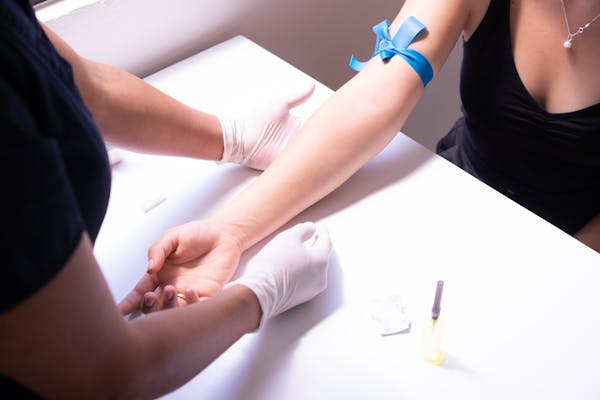
Apply tourniquet and select vein ≤1 minApply 3–4 inches above intended site. Palpate, assess quality and stability. Select the best site. Check for pulse — if pulsating, it's an artery.
6
Put on gloves PPEGloves go on at the patient's side, after site selection but before any patient contact with your hands. OSHA requires gloves for all phlebotomy.
7
Clean the site and allow to dry 30–60 sec dry70% IPA, concentric circles outward, air dry completely. Do not touch, fan, or blow. Re-clean if you touch the site again.
8
Prepare the needle assemblyAttach needle to vacutainer holder (do not remove needle cap yet). Place first tube in holder, ready to push. Confirm order of draw.
9
Anchor the vein and insert the needle 15–30° angleUse non-dominant thumb to anchor skin 1–2 inches below site. With bevel up, insert at 15–30° angle with a smooth, decisive motion. Observe blood flash in hub.
10
Release tourniquet On flashAs soon as blood flows into the first tube, release the tourniquet. This prevents hemoconcentration. Some protocols release before insertion — either is acceptable.
11
Fill tubes in order, inverting each as filledChange tubes without moving the needle. Invert each filled tube the required number of times. Never shake. Allow vacuum to fill tubes fully.
12
Remove needle and activate safety device OSHAWithdraw needle in one smooth motion. Immediately activate the safety shield with one hand. Place gauze on site simultaneously with non-dominant hand.
13
Apply pressure and dispose of needle NO RECAPPINGDiscard needle/holder assembly into sharps container without recapping. Apply firm pressure with gauze. Ask patient to hold or elevate arm.
14
Label tubes at bedside, in front of patient BEDSIDE ONLYApply pre-printed labels or hand-write: patient full name, DOB/MRN, date/time, phlebotomist initials. Label in front of the patient — never elsewhere.
15
Assess site and apply bandageConfirm bleeding has stopped. Apply bandage (check for adhesive allergy). Instruct patient: keep on for 15 minutes, avoid heavy lifting for 1 hour.
16
Remove gloves and perform hand hygiene WHO Moment 5Gloves off without contaminating hands. Hand hygiene. Thank the patient. Transport specimen to lab per protocol within required timeframes.
📐 Needle Angle & Insertion Technique
Vein Type
Angle
Notes
Superficial, easily visible
10–15°
Shallow entry; avoid going through the vein
Standard antecubital vein
15–30°
Most common; bevel up
Deep vein (obese patient)
30–45°
More vertical; anchor firmly
Hand/finger veins
10–15°
Very superficial; use butterfly
⚠️Bevel Always Up: The bevel (slanted cutting edge) of the needle should face up during insertion. This ensures the sharpest edge enters first, minimizing tissue damage, and allows blood to flow from both the lumen opening and the bevel opening.
🧠 Procedure Flashcards
Tap to flip
At what angle should the needle be inserted for a standard antecubital draw?
15–30° above the skin surface, bevel up. Too steep risks going through the vein; too shallow risks missing it.
When do you release the tourniquet during a draw?
As soon as blood flows into the first tube (on flash) — or before insertion per some protocols. Must be within the first few seconds of collection.
When do you label the tubes?
Immediately after collection, at the bedside, in front of the patient — every time, without exception.
After needle removal, what is the FIRST action?
Activate the safety device immediately with one hand. Then apply gauze and pressure. Disposal comes after safety is engaged.
Tube may be positioned at angle — rotate the tube handle slightly
Needle may have passed THROUGH the vein — slowly withdraw 1–2mm (redirect slightly)
Bevel may be against the vein wall — rotate the needle 45°
Tourniquet may have slipped — may need to reposition
Scenario 2 — Blood flows then stops:
Patient moved arm — reanchor and try not to follow movement
Vein collapsed (fragile vein, high vacuum) — try releasing tourniquet, allow to refill, use lower-vacuum tube
Hematoma forming — blood is going into tissue, not tube. Withdraw immediately, apply pressure.
Scenario 3 — Vein rolls away:
Anchor below the site by pulling skin taut with your non-dominant thumb
Approach from slightly below the vein (more acute angle) to catch it before it moves
For very mobile veins: anchor aggressively from below AND above the site
Scenario 4 — Hematoma forming during draw:
A lump is growing under the skin at or near the insertion site — blood is escaping the vein into tissue
Remove the tourniquet first, then the needle. Apply firm pressure for at least 5 minutes.
Document and alert the patient to the hematoma, instruct on monitoring
📝 Knowledge Check
1. During insertion, you should hold the needle with:
Bevel up ensures the sharp cutting edge enters first, reduces trauma, and allows blood to flow from both the tip lumen and the bevel edge. Bevel down causes more pain and tears tissue unnecessarily.
2. The last tube is filled and you're ready to remove the needle. The correct sequence is:
OSHA-compliant sequence: withdraw needle → immediately activate safety with ONE hand → apply gauze simultaneously → dispose in sharps container. Never recap. Never walk to a sharps container with an unprotected needle.
3. After the blood draw, the patient should be instructed to keep the bandage on for:
Standard recommendation: bandage for 15 minutes minimum. For patients on anticoagulants (warfarin, heparin, Xarelto) or aspirin — hold direct pressure until fully hemostatic and extend bandage time accordingly. Heavy lifting should be avoided for 1 hour.
⚡ Live It — Real-World Scenario
👶 Live It — The Heel Stick First Drop
You are performing neonatal screening. You've prewarmed the heel, cleaned with alcohol, and made a safe lancet puncture on the medial plantar surface. The first drop appears.
💬 What do you do with the first drop of blood and why?
Wipe away the first drop — do not use it. (1) The first drop contains interstitial fluid that dilutes the sample and skews electrolytes, glucose, and hemoglobin. (2) Wipe with clean, dry gauze completely. (3) Allow the second drop to form with gentle pressure — do NOT squeeze aggressively (causes hemolysis). (4) Touch the collection device to the second drop. (5) For NBS filter paper, fill each circle completely in one touch — partial circles are rejected. Never layer or scrape the skin.
Coach Phoebe
Difficult veins aren't failures — they're learning opportunities. Each one teaches you something.
📢 Share It — Study Cards & Patient Education
📇 Flip Cards — Study with a Partner
Tap each card to reveal the answer
Why is the first drop discarded in capillary collection?
Contains tissue/interstitial fluid that dilutes the sample and alters glucose, electrolytes, and cell counts.
What sites are used for capillary puncture in adults vs. infants?
Adults: lateral fingertip (3rd or 4th finger). Infants: medial or lateral plantar surface of heel only — never posterior heel or fingers.
🏥 Patient Education Tip
A heel prick uses just a tiny drop of blood and is used for newborn screening and patients where vein access is limited.
Finger sticks and heel sticks produce capillary blood — a mix of arterial, venous, and interstitial fluid. Different specimen, different rules.
⭐ 45 XP on completion
Antiseptic Technique: Circular Motion & Drying Time
✨ To best master this material, we use a Learn It → Live It → Share It approach: read the concept, apply it in a real scenario, then reinforce with shareable study cards.
💡 When to Use Dermal Puncture
Infants and neonates (heel stick preferred for <12 months)
Small children — finger stick preferred over 12 months
Adults with extreme difficulty finding venous access
Patients requiring only small volume specimens
Home blood glucose monitoring
⚠️Capillary ≠ Venous: Capillary blood has slightly different reference ranges than venous blood. Blood glucose from a fingerstick is typically 3–4 mg/dL higher than venous glucose. Labs must note the specimen source.
👆 Fingerstick Technique
Site Selection
Preferred: 3rd (middle) or 4th (ring) finger, non-dominant hand
Puncture the fleshy pad of the fingertip — slightly to the side of center, not the very tip
Avoid: thumb (arterial pulse nearby), index finger (most sensitive), pinky (too thin), any finger with calluses, scars, edema, or poor circulation
Depth
Adults: 1.8–2.0 mm depth lancet
Children: 1.0–1.5 mm depth lancet — CLSI-recommended pediatric lancet
Warm the fingerWarm towel or commercial warmer for 3–5 minutes to increase capillary blood flow.
Clean with 70% IPA and allow to drySame as venipuncture — must be fully dry before puncture.
Puncture with a single-use safety lancetPress firmly and activate — do not re-use lancets. Activate with confidence; hesitation creates a shallow puncture and tissue squeezing.
Wipe away the FIRST drop of bloodThe first drop contains excess tissue fluid (interstitial) which can dilute the specimen. Wipe and discard it.
Collect from free-flowing dropsAllow drops to form and collect without squeezing. Light gentle pressure is okay; MILKING (compressing the finger toward the tip) introduces tissue fluid and is not acceptable.
Fill capillary tubes or test devicesHold collection device horizontally or slightly downward. Fill blood gas tubes completely without introducing air.
🚨No Milking: Squeezing the finger (milking) introduces interstitial fluid which dilutes all analytes — especially potassium, hemoglobin, and glucose. This can produce false results. Encourage free-flowing blood through warming, not squeezing.
👶 Heel Stick — Neonates & Infants
When It's Used
Heel stick is the required method for infants under 12 months and neonates — their veins are too small and their bones are too close to the finger surface for safe finger puncture.
Site
Medial or lateral plantar surface of the heel (NOT the posterior heel — calcaneous bone is too close)
Maximum depth: 2.0 mm in neonates; never exceed this — risk of osteomyelitis (bone infection)
Comparison
Fingerstick
Heel Stick
Patient population
>12 months, adults
Neonates, <12 months
Site
3rd/4th finger pad, lateral
Medial/lateral plantar heel
Max depth
1.8–2.0 mm adults
2.0 mm neonates
First drop
Wipe and discard
Wipe and discard
Milking allowed?
No — tissue fluid contamination
No — same reason
👆 Capillary Blood vs. Venous Blood — Key Differences
Capillary blood is a mixture of arterial blood, venous blood, and interstitial fluid — it is NOT identical to venous blood. This has significant implications for test interpretation:
Analyte
Capillary vs. Venous
Clinical Significance
Glucose
Capillary 20–70% higher in fed state
POC glucometers are calibrated for capillary blood — not interchangeable with venous plasma glucose without adjustment
Hemoglobin
Similar unless patient is in shock
In circulatory compromise, capillary Hgb may be unreliable
Potassium
Capillary ≥ venous due to cell damage from squeezing
Do not squeeze fingerstick excessively — always compare to venous K⁺ if unexpected elevation
Total protein
Higher in capillary (interstitial fluid dilution is less)
Protein reference ranges are optimized for venous blood
When capillary is the RIGHT choice:
POC glucose monitoring (glucometer) — specifically designed for capillary blood
Neonatal screening (heelstick for PKU, thyroid, etc.) — standard of care
Blood gas from capillary in neonates (arterialized capillary) — warming heel increases arterial contribution
Patients with no accessible veins AND only small volumes needed
1. For a fingerstick on an adult, which fingers are PREFERRED for puncture?
3rd and 4th fingers are preferred — they have adequate fleshy tissue, fewer nerve endings than the index finger, and are not adjacent to arteries (thumb). Non-dominant hand is preferred to minimize discomfort in daily activities after the draw.
2. After a fingerstick puncture, the first drop of blood should be:
The first drop of blood from a fingerstick is diluted with interstitial (tissue) fluid that accumulates from the puncture trauma. Wiping it away ensures the collected sample is true capillary blood with accurate analyte concentrations.
3. For a heel stick on a 1-week-old neonate, the safe puncture site is:
The posterior heel is over the calcaneous bone — puncturing here risks osteomyelitis (bone infection). The medial and lateral plantar surfaces have adequate subcutaneous tissue for safe puncture at 2.0 mm max depth. Toe sticks are contraindicated in infants.
⚡ Live It — Real-World Scenario
🏷️ Live It — The Labeling Error
After a 4-tube draw, you realize you grabbed pre-printed labels from the adjacent patient's folder. Two tubes are already labeled with the wrong patient's name.
💬 What are your exact next steps?
Do NOT cross out, relabel, or correct — these specimens must be rejected. (1) Remove both mislabeled tubes from circulation immediately. (2) Label them "MISLABELED — DO NOT USE." (3) Dispose per facility protocol. (4) Draw a fresh set for the correct patient. (5) Label at the bedside immediately after confirming patient identity again. (6) Complete an incident/event report — this is a near-miss quality event. (7) Notify your supervisor.
Coach Phoebe
The tourniquet is a tool, not a vice. One minute max, then release!
📢 Share It — Study Cards & Patient Education
📇 Flip Cards — Study with a Partner
Tap each card to reveal the answer
When must specimen labels be applied?
At the bedside, in the patient's presence, immediately after collection. Never pre-label or label away from the patient.
What information must be on every specimen label?
Full name, DOB or MRN, date/time of collection, phlebotomist initials, collection site (if relevant).
🏥 Patient Education Tip
Your phlebotomist labels your blood tubes right in front of you. This ensures your samples are always connected only to you.
A perfect draw means nothing if the specimen is mislabeled, hemolyzed, or processed incorrectly. The chain of custody ends with you.
⭐ 40 XP on completion
7-Step Venipuncture Sequence
✨ To best master this material, we use a Learn It → Live It → Share It approach: read the concept, apply it in a real scenario, then reinforce with shareable study cards.
🏷️ Required Label Information
Every specimen tube must have a label with the following minimum information:
Patient's full legal name
Patient's date of birth and/or MRN
Date and time of collection
Phlebotomist's initials or ID
Tube type and test requested (if not on pre-printed label)
🚨Label at Bedside, Always: Labels go on at the bedside, in front of the patient, immediately after collection. Pre-labeling tubes before collection is a WBIT risk. Labeling at the nursing station away from the patient is not acceptable and may be a reportable event at accredited facilities.
🌡️ Temperature & Transport Requirements
Test / Tube
Temperature
Transport Notes
Most chemistry, CBC
Room temperature
Transport within 2 hours of collection
Glucose (gray tube)
Room temperature
Stability: 24 hrs with fluoride
Coagulation (light blue)
Room temperature
Process within 4 hours; keep capped
Blood cultures
Body temp / 35–37°C
Incubator; never refrigerate
Ammonia
Ice/cold water
Transport on ice immediately
Lactic acid (lactate)
Ice
Transport on ice; process within 15 min
Arterial blood gas (ABG)
Ice (if >15 min delay)
Analyze within 15 min or ice
Bilirubin
Room temp — PROTECT FROM LIGHT
Wrap in foil; light degrades bilirubin
Cold agglutinins
Body temp / 37°C
Keep warm — transport in heated container
⚠️ Hemolysis — The #1 Specimen Rejection Cause
Hemolysis is rupture of red blood cells, releasing intracellular contents into the serum/plasma. A hemolyzed specimen appears pink to red and is frequently rejected by the laboratory.
Causes of Hemolysis
Inserting through wet alcohol
Using too small a needle (excessive shear force) — avoid 25G for large-volume draws
Excessive vacuum / too rapid filling speed
Vigorous shaking or mixing of tubes
Prolonged tourniquet time (>1 minute)
Drawing from an IV site or above an IV line
Hematoma in the collection site
Improper transport (extreme temperatures)
Effects on Test Results
Potassium: Falsely elevated (major intracellular ion released from RBCs)
🏷️ Chain of Custody — When Documentation Becomes Legal Evidence
Chain of custody (COC) is a documentation and handling protocol that establishes an unbroken record of who collected, handled, and tested a specimen — ensuring it could not have been tampered with or substituted. COC specimens have legal implications: employment drug testing, forensic specimens, paternity testing, DUI blood draws, and legal blood alcohol levels.
COC collection requirements (substantially stricter than routine):
Patient must provide photo ID — no ID = no collection (or special protocol)
Patient should not be left unaccompanied to produce a urine specimen
Collector must observe/witness urine temperature immediately after collection (90–100°F = body temperature; outside range = specimen may be adulterated)
Specimen is sealed in tamper-evident packaging in the patient's presence
Patient must initial or sign the seal
Collector documents every transfer of custody with time, date, name, and reason
Any break in the chain can render the specimen legally inadmissible
Blood alcohol (legal): Not drawn with isopropyl alcohol prep — this would contaminate the specimen with alcohol. Instead, use povidone-iodine (Betadine) or soap and water to clean the site. Document the prep solution used — defense attorneys will ask.
Never assume COC: Always ask the ordering nurse/physician "Is this a chain of custody specimen?" Treating a routine drug screen as non-COC — or vice versa — can have significant legal consequences for the patient and liability for the facility.
📝 Knowledge Check
1. A specimen for bilirubin testing must be:
Bilirubin is photosensitive — exposure to light degrades it rapidly, producing falsely LOW results. Amber-colored tubes or wrapping with foil protects the specimen. Temperature is room temperature — not cold.
2. A serum specimen appears pink/red. This indicates:
Hemolysis turns serum/plasma pink to red because free hemoglobin from lysed RBCs colors the fluid. Lipemic serum is cloudy/white (from fats). Normal serum is yellow/straw-colored. A pink/red specimen is typically rejected for potassium, LDH, and other affected analytes.
3. Blood cultures should be transported:
Blood culture bottles contain live bacteria (if infection is present). They must be incubated at body temperature to allow bacterial growth to a detectable level. Refrigeration kills or inhibits bacteria and produces false-negative cultures — a dangerous result in a septic patient.
⚡ Live It — Real-World Scenario
🚚 Live It — Delayed Courier
You collected a green-top (heparin) cortisol tube and a light-blue coagulation tube at 2:00 PM. The courier won't arrive for another 2 hours. It is now 3:00 PM.
💬 What actions preserve specimen integrity?
Both specimens are time-sensitive: (1) Light-blue PT/INR: Must be tested within 4 hours at room temp — centrifuge immediately, separate plasma, store at 2-8°C. (2) Green-top cortisol: Centrifuge now, separate plasma — stable refrigerated for 24-48 hours. (3) Document collection time and all storage actions taken. (4) Notify the lab of the delay. (5) Do NOT freeze coagulation specimens. Know each tube's specific storage requirements.
Coach Phoebe
Needle gauge selection matters. Match the gauge to the patient and the test.
📢 Share It — Study Cards & Patient Education
📇 Flip Cards — Study with a Partner
Tap each card to reveal the answer
How long is a light-blue tube stable for PT/INR at room temp?
Up to 4 hours after collection. Separate plasma and refrigerate for up to 24 hours.
Which specimens require protection from light during transport?
Bilirubin, Vitamin B12, folate, beta-carotene, and certain porphyrins degrade with light exposure.
🏥 Patient Education Tip
Blood samples are carefully stored and transported to ensure accurate results. Temperature and timing matter for some specialized tests.
Not every draw goes perfectly. Knowing what to do when things go wrong — and how to prevent common problems — defines professional competence.
⭐ 45 XP on completion
Needle Angle (15-30°) & Bevel Position
✨ To best master this material, we use a Learn It → Live It → Share It approach: read the concept, apply it in a real scenario, then reinforce with shareable study cards.
🩸 No Blood Flow — Troubleshooting Guide
Problem
Likely Cause
Correction
No flash, no flow
Needle not in vein (short of or past it)
Slowly advance or slightly withdraw needle — do not probe laterally
Tube fills then stops
Vein collapsed from excess vacuum
Switch to butterfly or syringe; reduce vacuum with smaller tube
Slow trickle of blood
Tourniquet too tight (arterial occlusion) or vein is small
Release/reapply tourniquet; use 23G butterfly with smaller tubes
⚠️Two-Attempt Rule: Most facilities limit each phlebotomist to a maximum of two venipuncture attempts. If unsuccessful after two attempts, contact a supervisor or a more experienced phlebotomist. Do not continue probing.
🩹 Hematoma
A hematoma is a localized collection of blood in the tissue surrounding the puncture site — the most common complication of venipuncture.
Causes
Needle penetrating through both walls of the vein
Insufficient pressure after needle removal
Patient bending arm (raises venous pressure) instead of keeping it straight
Needle movement during collection
Multiple punctures in the same area
Anticoagulant therapy
Management
Remove needle immediately if hematoma develops during collection
Apply firm direct pressure for 5+ minutes (longer for anticoagulated patients)
Apply ice pack to reduce swelling
Document the event in the patient's chart
Never use the hematoma site for repeat collection
⚡ Other Complications
Complication
Signs
Action
Petechiae
Small red dots around site from tourniquet
Release tourniquet sooner; may indicate thrombocytopenia
Nerve injury
Sharp/electric pain shooting down arm during insertion
Remove needle immediately; document; report to supervisor
Hives, itching at contact; anaphylaxis in severe cases
Remove tourniquet; call for help; follow facility emergency protocol
Syncope (fainting)
Pallor, diaphoresis, loss of consciousness
Remove needle; lower patient; cool compress; call for help
Excessive bleeding
Soaking through bandage
Reapply pressure; notify nursing; do not leave patient
🚨Nerve Injury — Immediate Action Required: If a patient reports a sharp, electric, or shooting pain during insertion (not the typical "pinch"), withdraw the needle immediately. Nerve damage is one of the most serious phlebotomy complications and can result in permanent injury and legal liability.
⚡ Nerve Injury During Venipuncture — Prevention and Response
Nerve injury is one of the most serious complications of venipuncture and a significant source of phlebotomy-related litigation. It most commonly occurs when drawing from the basilic vein (medial side), which is in close proximity to the medial cutaneous nerve of the forearm and, in some patients, the median nerve.
Signs of nerve contact during insertion:
Sharp, shooting pain that travels down the arm or into the fingers (not just at the puncture site)
Patient suddenly pulls arm away or cries out — beyond normal draw discomfort
Electric sensation or numbness radiating from the site
Immediate response to suspected nerve contact:
Remove the needle immediately — do not try to redirect
Apply pressure to the site
Acknowledge: "I may have touched a nerve — I'm very sorry. The sensation should resolve."
Document in detail: exact site, sensation described, your response
Report to supervisor and complete an incident report
Most nerve contacts resolve within minutes to hours. Persistent numbness, weakness, or pain lasting more than 24 hours should be evaluated by a physician.
Prevention:
Choose median cubital as first choice — lowest nerve proximity
Never use the basilic vein as a first attempt
Do not redirect the needle laterally while inside the vein — withdraw and re-insert
1. During venipuncture, you notice the site swelling immediately around the needle. This indicates:
Swelling at the puncture site during collection indicates the needle has gone through or beside the vein and blood is infiltrating tissue (hematoma). Remove the needle immediately, apply firm pressure, and apply ice. Do not attempt to continue collection at that site.
2. During needle insertion, a patient cries out and reports a shooting electrical pain down their forearm. You should:
Electric or shooting pain is a red flag for nerve contact or injury. Remove the needle immediately without any lateral movement. Document the event. The patient should be monitored and may need medical evaluation. Continuing despite nerve pain is negligent.
3. After two failed venipuncture attempts, you should:
The two-attempt limit is standard in most facilities. After two failed attempts, escalate to a supervisor or colleague. Patient comfort and safety take priority over specimen collection. Additional attempts by a more experienced or differently-trained colleague may succeed where standard technique fails.
⚡ Live It — Real-World Scenario
🍳 Live It — Fasting Failure
You arrive to collect a fasting lipid panel from Mrs. Patel. She confesses she had a granola bar and coffee with cream about 3 hours ago.
💬 What do you do, and what do you tell Mrs. Patel?
Do not collect without informing the provider. (1) Notify the ordering provider: "Mrs. Patel has not fasted — she consumed food/beverage 3 hours ago." (2) The provider decides: reschedule or draw with non-fasting notation. (3) If provider says collect: label clearly "NON-FASTING — consumed [food] at [time]." (4) A lipid panel post-meal shows elevated triglycerides (50-150% higher) and elevated glucose. (5) Never hide the information — a falsely normal fasting result could mislead treatment.
Coach Phoebe
A clean venipuncture starts with proper skin prep. Don't touch the site after cleaning!
📢 Share It — Study Cards & Patient Education
📇 Flip Cards — Study with a Partner
Tap each card to reveal the answer
Which tests commonly require a 12-hour fast?
Fasting lipid panel, fasting glucose, and metabolic panels when specified.
How does a non-fasting state most affect lab results?
Triglycerides are most affected (50-150% higher). Glucose rises. Some electrolytes and hormones also shift after eating.
🏥 Patient Education Tip
If you ate before a fasting blood test, please tell us before your draw. We won't judge — your provider needs accurate results to make good decisions.
Apply everything you've learned. These scenarios test your full procedure knowledge — from patient ID through specimen transport. Week 3 clinicals start soon.
⭐ 45 XP on completion
Complete Phlebotomy Procedure Checklist
🏥 Integration Scenarios
Scenario 1: Wrong Order Caught
You are collecting a CBC (lavender), BMP (green), and PT/INR (light blue) on the same patient. You accidentally drew the lavender tube first. The light blue tube is in your hand, ready to insert next.
EDTA carryover (lavender → light blue) produces falsely prolonged coagulation times. Notify the lab — they may accept the specimen if the clinical urgency is high, or require a redraw. Transparency and communication prevent patient harm. Never hide collection errors.
Scenario 2: Blood Culture Collection
A physician orders blood cultures (2 sets) × 2 sites plus a CBC and BMP on a febrile 58-year-old patient. How do you sequence and approach this collection?
Blood cultures come first in the order of draw (sterile technique, separate sites, 2-step antisepsis). Two sets from two different sites increases diagnostic sensitivity from ~80% to ~95% for bacteremia. CBC and BMP then follow in standard order from a third site. Never use the same site for cultures and routine draws.
Scenario 3: The Specimen Rejected
The lab calls to say they're rejecting a light blue tube you sent 20 minutes ago because it is hemolyzed AND underfilled. The patient is a difficult draw, now with a bandage on both arms from your attempts. What do you do?
A hemolyzed underfilled coagulation specimen cannot be used. Notify the provider (they need to know results will be delayed). Then collaborate — a nurse specialist, anesthesiologist, or ultrasound-guided access may be needed. Never exceed two attempts without escalation, and document all attempts and communications thoroughly.
Scenario 4: Labeling Error Discovered
You collected 4 tubes from Patient A in Room 201. After leaving the room, at the nursing station, you realize you applied Patient B's labels (Room 203) on the tubes. Nobody else knows yet.
Mislabeled specimens must be DISCARDED — not re-labeled. Relabeling a specimen at the nursing station is a WBIT event, not a fix. The specimen must be recollected correctly. All labeling errors are reportable incidents under TJC and accreditation standards. Transparency prevents the greater harm of treating the wrong patient based on wrong results.
🎯 JEOPARDY CHALLENGE
Team vs. Team — select a category and point value to challenge!
🔵 Team A 0
🔴 Team B 0
Cat 1
Cat 2
Cat 3
100
100
100
200
200
200
300
300
300
✅ Answer
📢 Share ItTeach It to Own It
Research shows that teaching a concept is the single most powerful way to solidify it in long-term memory. Explain each prompt aloud — to a partner, to yourself, or to a clinical instructor.
Teach Back 1: Recite the full order of draw from memory and explain WHY each tube follows the next in that sequence.
Teach Back 2: Walk a classmate through the 16-step venipuncture procedure step-by-step without looking at your notes.
Teach Back 3: Explain to a peer the difference between serum, plasma, and whole blood — and name a test that requires each.
Teach Back 4: Teach back: what happens physiologically if you draw a light blue tube with the wrong fill volume?
🤝 Peer Coaching Activity
Role Play: Student A reads a lab order aloud. Student B selects the correct tube colors, states the order of draw, and explains one potential complication for each tube. Instructor or peer scores accuracy.